Friday, May 6, 2011

A new biogas cogeneration plant in Wisconsin will provide a landfill alternative to several materials recyclers traditionally have discarded.

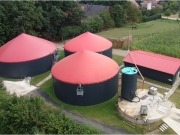
Powerful Ending - ImageThe University of Wisconsin Oshkosh (UWO) is installing a biogas cogeneration plant that will divert a number of materials away from the landfill while also providing electrical power and heat to the campus.

A key technology provider for the new biogas system is Cenergy Power Systems Technologies Inc., Orange Park, Fla., which is owned in part by its management team and in part by Germany-based 2G Bio-Energietechnik AG.

Cenergy (www.2g-cenergy.com) describes the combined heat and power (CHP) system being installed as “the first dry fermentation anaerobic biodigester in the nation, which will convert yard and food waste into biogas.”

Michael J. Turwitt, the president and CEO of Cenergy, says the system at UWO and others like it will provide quick return-on-investment (ROI) for the corporations and institutions that install them, by providing energy internally without the monthly utility bill as well as by saving on waste hauling and disposal costs.
 

Read more : http://www.recyclingtoday.com/0411-powerful-ending.aspx

Monday, May 2, 2011

Safety Solutions Tailored to Biogas Plants

While the complexity of biogas plants tends to be underestimated, operators have sole responsibility for ensuring the safety and health of employees and the general public.
By Johannes Steiglechner and Volker Schulz | April 29, 2011
In late 2009, a study carried out by the Commission for Plant Safety of the German Federal Environment Ministry revealed critical defects in more than 60 percent of biogas facilities inspected. The study inspectors, which also included TÜV SÜD experts, detected weaknesses not only in the gas and ventilation systems, and regarding explosion protection, but also in component design, structural engineering and organizational measures.

This result confirms that stakeholders in practice still tend to underestimate the scope of required safety measures. Ensuring the safe operation of biogas facilities requires consideration of questions related to the gas, the electrical and the pressure systems. Other significant issues are related to fire safety and lightning protection, and to the layout and planning of escape routes and emergency response plans. Potential hazards to health and the environment also need to be limited.

Read more : http://biomassmagazine.com/articles/5489/safety-solutions-tailored-to-biogas-plants/

Icelandic Pigs to Power One Thousand Methane Cars

traffic-low_pkThe first power plant in Iceland which will use biological waste to produce methane is scheduled to open by the end of next year. The project is estimated to cost between ISK 350 and 400 million (USD 3.1-3.6 million, EUR 2.1-2.4 million).

The pork producer Stjörnugrís and energy company Metanorka are planning to sign a declaration of intent on using waste from Stjörnugrís’s pork farm at Melar in Melasveit, west Iceland, to produce methane which could power up to 1,000 vehicles, Fréttabladid reports.


Managing director of Stjörnugrís Geir Gunnar Geirsson believes the project is economical. “We will save foreign currency worth at least [ISK] 120 million per year.”


Le public et le privé s’arrachent nos sacs verts

L’industrie québécoise de la collecte des matières résiduelles traverse actuellement d’importants bouleversements. Les entreprises privées, comme RCI Environnement ou Waste Management, rivalisent désormais avec le secteur public pour accroître leurs parts de marché.


Des centaines de millions de dollars sont en jeu car la collecte des matières résiduelles génère des revenus de 1,3 G$ chaque année au Québec. Plusieurs compagnies privées consolident leurs activités en acquérant des concurrents. Elles veulent conserver leur position et empocher les lucratives recettes générées par la vente de matières recyclables, comme le carton ou le plastique.


La croissance du chiffre d’affaires des firmes privées a commencé à ralentir il y a quelques années lorsque le secteur public a accru sa présence dans la gestion des matières résiduelles.

Lire la suite : http://argent.canoe.ca/lca/affaires/quebec/archives/2011/04/20110429-180601.html

Le biogaz à la ferme : éléctricité et chauffage par méthanisation

4000 exploitations agricoles allemandes produisent aujourd'hui du biogaz avec leur fumier ou lisier. En France, nous en sommes seulement à 35 projets... et pourtant cette énergie renouvelable est fournie chaque jour par les excréments des animaux !

Pour bien comprendre de quoi il s'agit nous avons interrogé Pierre Besancon (35 ans), installé en Gaec avec sa femme et son jeune frère à Saint Berthevin en Mayenne.

Lire la suite : http://www.frequenceterre.com/chroniques-environnement-290411-2241-Le-biogaz-a-la-ferme-electricite-et-chauffage-par-methanisation.html

Wednesday, April 13, 2011

China to cut Nuclear & Increase Solar Power Goals after Japan Crisis

China hasn’t taken long to learn a lesson from the Japan nuclear crisis (perhaps). It is cutting its 2020 target for nuclear power and is filling in with increased solar power targets, according to an official from the National Development and Reform Commission (NDRC).


China recently passed up the U.S. as the world’s leading energy consumer. What it does on this front is critical to the long-term livability of our planet (for humans, at least). It is great to see that it is not only cutting back on nuclear expansion (which is a very risky option until someone learns how to deal with nuclear waste that lasts several times longer than humans have existed for), but that it is also increasing its solar power goals to account for this.

Reportedly, Shi Lishan, deputy director of the renewable energy department of the National Energy Administration (NEA), announced yesterday that China is “seriously considering increasing its five year target for the PV industry capacity from 5 gigawatts (GW) to 10 GW” as well.

The previous 2020 target for nuclear was 80 GW and for solar it was 20 GW. The proposed changes have not been announced yet.

But while its 2020 targets are supposed to be changing, that may not change China’s plans in the long term.

Is China Going to Cut its Nuclear Goals in the Long-Term?

While it is clear that China is slowing down its nuclear development process, some are saying that it is not actually going to change the long-term goals of the country when it comes to nuclear. The slow-down will be to ensure that new nuclear plants are “safer” but it won’t necessarily cut the country’s eventual target.

“NDRC Vice Chairman Xie Zhenhua said [on Wednesday] that China won’t alter its atomic energy plans, even as the Cabinet had stopped approving new nuclear plants, pending safety checks.”
Cao Peixi, chairman of Huaneng Power International Inc, said the same thing at a press briefing yesterday. Want China Times writes: “China’s biggest electricity producer won’t alter its nuclear plans because of Japan, Cao said.”

Is this temporary halting of nuclear development just a play for the public? Or will safety checks, a change of short term plans, and probable cost increases reduce nuclear development in China? We’ll see….


Source : http://cleantechnica.com/2011/04/01/china-to-cut-nuclear-increase-solar-power-goals-after-japan-crisis/

German firms to drive global biogas market close to $9 billion by 2017


A comprehensive new report on biogas plants published by Global Industry Analysts, Inc. concludes that the world’s desire to reduce dependency on fossil fuels, heightened attention to eco-friendliness, and government incentive programmes will continue to step up investment in biogas facilities, which are forecast to $8.98 billion by the year 2017.
  German firms to drive global biogas market close to $9 billion by 2017“Narrowing cost differentials between fossil fuels based electricity generation and biogas energy in recent years has further augmented interest in renewable resources,” says Global Industry Analysts. “Today, biogas competes on par with petroleum-based fuels in terms of performance, cost, and other additional benefits such as reduce greenhouse gas (GHG) emissions.”
In terms of both consumption and production of biogas, Europe – especially Germany, followed by the UK, Italy and Spain – is ahead of other regions mainly due to increased government regulation for environment friendly initiatives. Although Europe dominates biogas production, the trend is also catching up fast in countries like Japan, Australia, New Zealand and the US. The Asia-Pacific biogas plants market is displaying strong appetite for growth, thanks to the continuous infrastructure development and business expansion in the region, especially in the emerging markets such as China and India.

Read more :  http://www.renewableenergymagazine.com/energias/renovables/index/pag/biogas/colleft/colright/biogas/tip/articulo/pagid/15020/botid/76/